What goes up must come down. That’s the basic law of gravity.
In the past 20 years the population of England has gone from 59.5 million to 67.7 million, a jump of 13.8 per cent.
Since we can’t ‘manufacture’ land, it’s fairly obvious that we need to make more available to house all these people.
Not on your Nellie. Forget gravity.
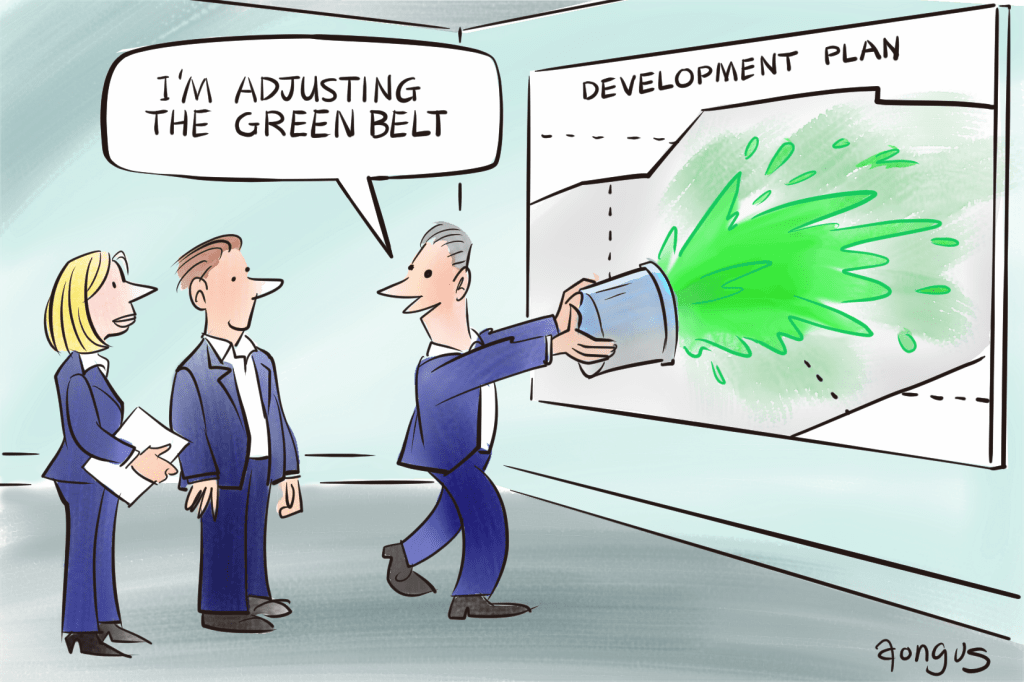
For the second year in a row, England’s green belt has increased and there is now more of it than there was 20 years ago.
But why, when the population is growing, are we reducing the amount of land available for homes?
After spending the last 30 years working with developers trying to get land out of the Green Belt – with some success, I might say – I would have thought it should be shrinking by now.
Not a bit of it. Last year (2022/3) there was an extra 24,150 hectares – an increase of 1.5%. Say we get a modest 20 homes per hectare – that’s almost 500,000 new homes.
Or, if we get a bit denser (don’t tempt me), at 40 per hectare we could get a million. At 60 per hectare, we get 1.5 million. There you are Kier, you can now meet your recent promise. Job done.
Which made me think: how is land added to the Green Belt?
Easily is the answer.
Last year North Hertfordshire Council, added 3,350 hectares (think 60,000 or 120,000 – if you want to be dense – new homes) of land to its green belt – a jump to of 24 per cent. This wiped out the 850 hectares of green belt land released by all the other authorities in England.
Talk about a Green Machine. This is a council that just four years ago told us that its Housing Land Supply of 1.3 years was ‘acute’. I can think of less kind words courtesy of Dominic Cummings.
North Somerset, is not an area you would normally associate with urban sprawl.
Out of the blue, it announced that it was removing three sites from the Green Belt and adding a single big one.
All of this shifting sand makes life difficult for people: for land owners who wake up one morning and find that they are in the Green Belt. This places huge restrictions on the land they own.
For example, you cannot turn your stable into a cattery as happened to the Tudor House Luxury Hotel in Shropshire where an Inspector refused retrospective planning permission because it might harm the Green Belt.
Promoting land is a high-risk business and just as the promoters (Boooo hissss) think they have a nice allocation on green belt land, someone shuffles the kaleidoscope and they’re out.
All I can offer is sympathy.
Have a good weekend
Tom

 by the Planning PR guru