
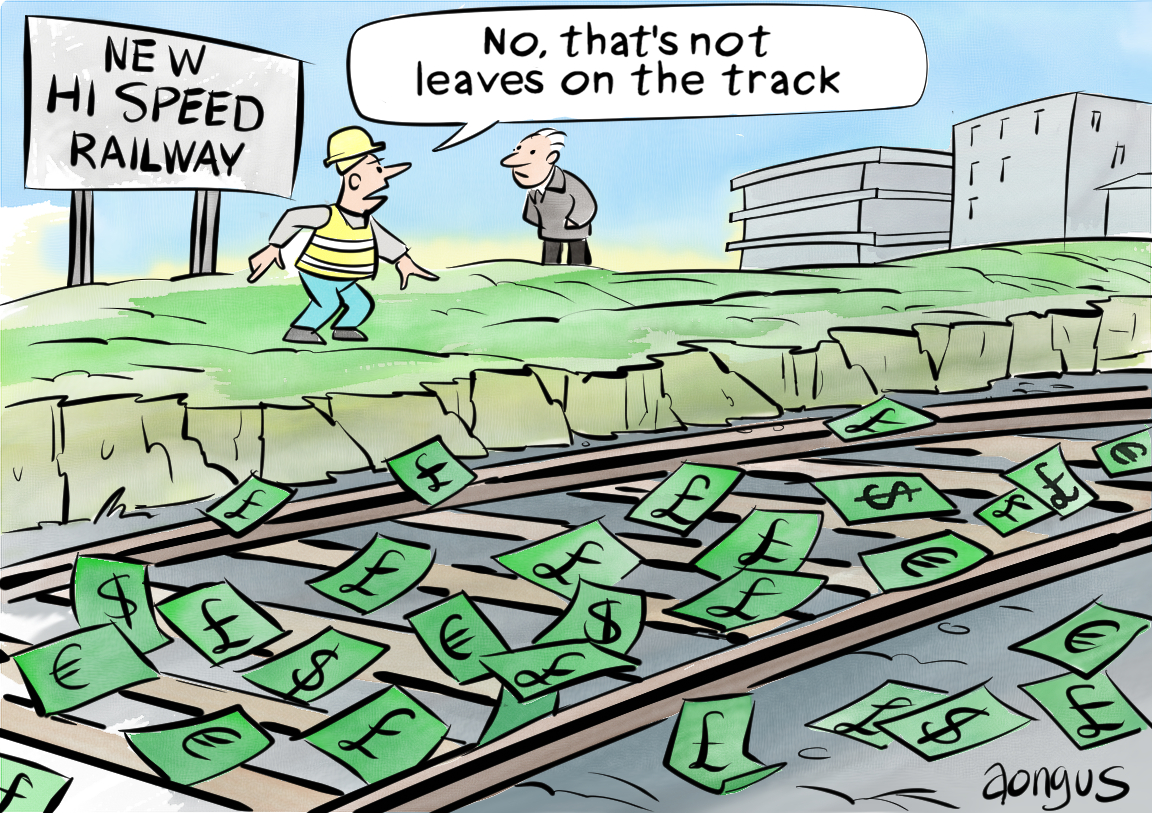
Why do major projects go off the rails?
Simple. Because they are major. It means they are complex.
As the satirist HL Mencken said: for every complex problem there is an answer that is clear, simple…and wrong.
This is not just a British phenomenon: it’s the same the world over. So don’t panic. We are all in la mierda together.
In Spain they commissioned some lovely new carriages for the railway system except they were too big for the tunnels. So, €250 million later it is back to the drawing board. It was a mix-up between the railway company and the operators. Sound familiar?
In Germany, where we got the word Teutonic (efficiency), Berlin Airport has opened ten years late and at a cost of €7 billion; it is three times over budget. Makes Crossrail and HS2 look like model of efficiency.
But surely the Yanks have this right with their emphasis on lean, mean capitalism. Nope. You must be joking. Plans to build a bullet train between San Francisco and Los Angeles have hit the buffers big time.
We all know that the shortest distance between two points is a straight line. Not in California. Thanks to pollical meddling, the route now has a sharp dogleg through the desert. Instead of starting at LA or SF, it started in the middle.
The Yanks brought in les messieurs français from SNCF to help sort the mess out. They quit in despair and went off to work in Morocco a country which they said was ‘less politically dysfunctional’.
Right now, it’s more than three times over its $33 billion budget and most reckon it will never be finished. And forget about the extension of San Diego (aka Leeds).
So how do get these projects back on the rails. The easiest way is to change the specification. This is called the HS2 Dodge.
Remember that the HS stands for High Speed. The other week I was on a train in Italy which was whizzing along at 300km/hour – that’s 180mph. It’s the same in France.
Originally, HS2 would leave the Europeans in its wake with trains of 250mph. This was then reduced to an average of 205mph, still not bad.
Now they’re talking about huge costs savings could be made by reducing the speed of MS2 (now renamed Moderate Speed 2) to 125mph. That’s where we were in the 70s. Or indeed the steam-driven Mallard of the 1930s.
Such is progress.
Have a good weekend.
Tom

 by the Planning PR guru